
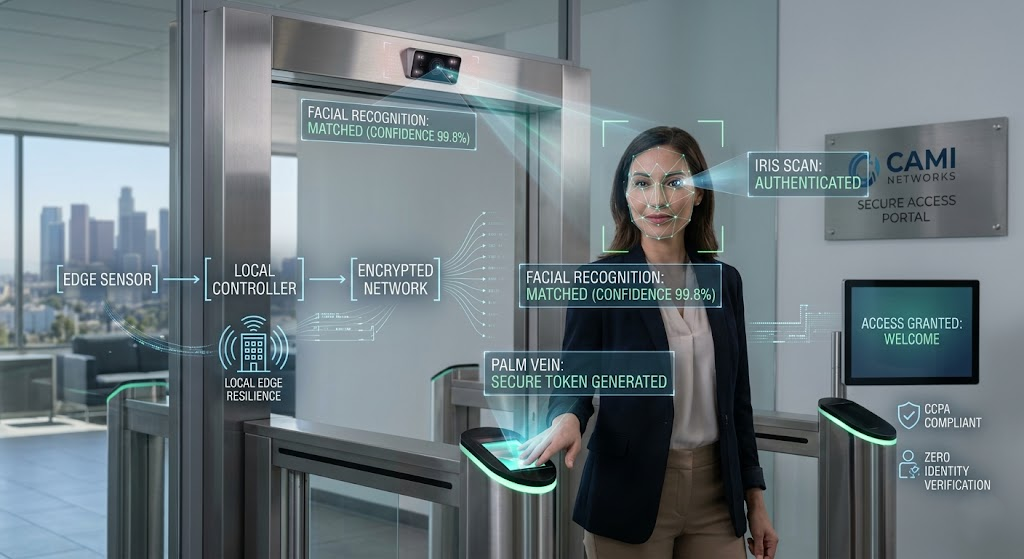
In an era where traditional security perimeters have completely evaporated, modern enterprises can no longer rely on legacy lock-and-key mechanisms or easily compromised digital credentials. As hybrid workforces expand and sophisticated physical-digital security threats escalate, organizations across California require absolute certainty regarding who is entering their facilities and accessing their network infrastructure.
Cami Networks delivers next-generation, high-assurance Biometric and Secure Access Control Services designed to eliminate identity spoofing, streamline workforce management, and enforce ironclad compliance frameworks. This comprehensive guide details the architectural paradigms, technological frameworks, and strategic benefits of implementing decentralized, biometric-driven physical security ecosystems.
The Evolution of Access Control: Moving Beyond the Badge
For decades, corporate physical security relied almost exclusively on standard Radio Frequency Identification (RFID) badges, key fobs, or alphanumeric PINs. While these solutions provided a basic barrier to entry, they suffer from fundamental, systemic vulnerabilities:
- Credential Theft and Loss: Physical badges are easily lost, stolen, or counterfeited.
- The “Buddy Punching” Phenomenon: Employees can easily share badges or PINs, skewing time-and-attendance metrics and invalidating audit logs.
- Zero Identity Verification: An RFID reader verifies only that the credential is authorized, not that the person holding it is the actual owner.
Biometric access control solves this root-cause vulnerability by transforming the user’s immutable biological characteristics into their cryptographic identity key. By binding access rights directly to the individual, organizations achieve a state of continuous identity assurance.
Architectural Breakdown: How Secure Biometrics Infrastructure Operates
A truly enterprise-grade biometric access ecosystem requires a meticulous integration of hardware edges, local edge-compute nodes, secure networks, and centralized identity providers (IdPs). Cami Networks deploys a highly resilient topology optimized for maximum uptime, split-second authentication latency, and uncompromised mathematical privacy.
1. Advanced Biometric Modalities
Modern deployments utilize multiple layers of physiological and behavioral identification:
- Facial Recognition with 3D Depth Sensing: Utilizing infrared structured-light projectors, systems map facial topology with millimeter accuracy. This approach prevents spoofing attempts via high-resolution photographs, video playbacks, or 3D masks.
- Optical and Capacitive Fingerprint/Palm Vein Scanning: Sub-surface vascular imaging maps the unique vein patterns beneath the skin. Because vein patterns are internal and invisible to the naked eye, they are virtually impossible to forge or replicate.
- Multispectral Iris Scanning: Capturing over 240 unique biometric data points within the iris structure, this modality provides the lowest False Acceptance Rate (FAR) available in commercial security.
2. Edge-Compute Processing and Tokenization
To ensure rapid ingress during peak operational hours, Cami Networks configures localized edge controllers at every access portal.
Crucially, raw biometric images are never stored or transmitted over the network. Upon initial enrollment, the physical sensor scans the trait and extracts key minutiae points. An algorithm converts these mathematical coordinates into an un-reversible, encrypted cryptographic token (hash).
When a user presents their biometric profile at a door, the system hashes the real-time scan and matches it against the stored mathematical token. Even if an adversary intercepts the database, it contains only randomized algorithmic data strings that cannot be reversed back into human faces or fingerprints.
3. Unified Physical-Logical Access Control (PACS/LACS)
The true power of modern access infrastructure lies in the convergence of physical access control systems (PACS) with logical access control systems (LACS). When integrated correctly, your physical security status dictates your digital network privileges:
- Geofenced Digital Access: An engineer cannot log into a secure server or database unless the physical access logs confirm they have badged into the physical server room.
- Instantaneous Global Offboarding: If an employee is terminated or their security status changes within your primary Identity Provider (Active Directory, Okta, Azure AD), their access to both physical office suites and corporate cloud software is instantly revoked worldwide.
Addressing Privacy, Compliance, and Data Sovereignty
Implementing biometric technology requires a strict adherence to local and international privacy laws. Operating heavily within California, Cami Networks aligns all deployments with strict regulatory mandates, including the California Consumer Privacy Act (CCPA), BIPA guidelines, and global frameworks like GDPR and SOC 2 Type II.
Data Security Framework
- End-to-End Encryption: All data moving between edge sensors, door controllers, and central management servers is encrypted using AES-256 at rest and TLS 1.3 in transit.
- Decentralized Storage Models: Organizations can choose to store tokenized profiles on a centralized, highly isolated on-premise server, within a secure cloud enclave, or written directly to an encrypted smart card held exclusively by the employee (Match-on-Card technology).
- Strict Retention Policies: Automated data scrubbing protocols ensure that visitor biometric logs, temporary contractor credentials, and stale user profiles are permanently purged in accordance with customized retention schedules.
Strategic Implementations Across Mission-Critical Industries
Every vertical faces unique operational constraints and security challenges. Cami Networks tailors secure access deployments to match the exact compliance and functional needs of your specific sector.
1. Commercial Real Estate & Multi-Tenant Office Enclaves
For property managers and enterprise office campuses, managing thousands of rotating tenants, visitors, and vendors is an administrative bottleneck.
- Frictionless Tenant Ingress: Eliminates the ongoing overhead costs of printing, tracking, and replacing physical proximity cards.
- Elevator Destination Dispatch Integration: Integrating facial or fingerprint portals at the building turnstiles automatically assigns visitors to specific elevators, routing them directly to their authorized floors while keeping restricted levels isolated.
2. Healthcare Facilities, Hospitals, and Pharmacies
Healthcare environments demand rigorous security to protect patient data, secure hazardous medical equipment, and control access to restricted substances.
- HIPAA & DEA Compliance: Biometric logging provides an irrefutable, unalterable audit trail proving exactly who accessed medication vaults, airborne infection isolation rooms (AIIR), and data centers housing Protected Health Information (PHI).
- Contactless Wave-to-Open Portals: Utilizing touchless facial recognition or wave-to-open palm sensors allows clinical personnel to pass through secure cleanrooms and surgical suites without compromising sterile hand washing techniques.
3. Logistics, Warehousing, and Supply Chain Hubs
High-throughput logistics facilities must balance rapid cross-docking workflows with stringent asset protection.
- Anti-Passback Protocols: Prevents an authorized worker from badging into a secure distribution wing and then passing their credential backward to an unauthorized individual.
- Loading Dock Control: Integrates dual-factor biometrics at logistics bays to ensure only certified forklift operators and vetted transport personnel can unlock heavy cargo gates or enter specialized inventory zones.
Engineered for Local Resilience: Why Regional Infrastructure Matters
A secure access system is only as reliable as the underlying network topology supporting it. Deploying security assets requires deep localized expertise to ensure that environmental factors, regional building codes, and internet connectivity disruptions do not compromise structural safety.
1. True Local Edge Continuity (Offline Fail-Safe)
Cami Networks architectures guarantee that even during complete wide-area network (WAN) blackouts, regional power outages, or cellular carrier drops, your physical facilities remain entirely secure and functional. Local controllers retain a synchronized database cache at the door level. If cloud or internet connectivity drops, authentication processing occurs instantly on-site, allowing uninterrupted access to authorized personnel while maintaining full lockdown protocols against intruders.
2. Seamless Retrofitting of Legacy Hardware
Transitioning to advanced biometric security does not require ripping out miles of existing internal cabling. Engineers specialize in retrofitting current configurations—integrating modern biometric readers over existing Wiegand or OSDP (Open Supervised Device Protocol) wiring back to your existing low-voltage control panels. This methodology vastly reduces upfront capital expenditure while immediately upgrading your security perimeter to modern standards.
Selecting Your Secure Access Architecture
When designing a modern access perimeter, organizations can configure their infrastructure across three distinct archetypes based on their risk tolerance and IT strategy:
| Feature/Capability | On-Premises Air-Gapped | Cloud-Managed SaaS | Hybrid Edge Architecture |
|---|---|---|---|
| Data Sovereignty | Absolute Local Control | Vendor Cloud Managed | Tokenized Edge / Secure Sync |
| Scalability | Manual Per-Site Provisions | Instant Global Scale | Tiered Multi-Site Clusters |
| Offline Performance | 100% Autonomous | Limited (Requires Cache) | Full Edge Autonomy |
| API Integrations | Custom SDK Required | Rich RESTful/Webhooks | Unified Local & Cloud API |
| Best Suited For | Defense, Aerospace, High-Value Vaults | Distributed Offices, Tech Startups | Healthcare, Enterprise Logistics |
Partnering with Cami Networks for Next-Gen Security
Securing your organizational perimeter is an ongoing, evolving discipline. From initial site surveys and low-voltage engineering to software identity provider integrations and compliance auditing, Cami Networks provides a flawless deployment pipeline executed by elite technical specialists.
Protect your assets, streamline your workforce operations, and eliminate the liabilities of legacy security systems. Contact Cami Networks today to schedule a comprehensive, on-site physical security assessment and discover how tailored biometric access control can future-proof your enterprise infrastructure.