
In the era of cloud computing, smart buildings, and instant connectivity, it’s easy to focus entirely on software and wireless devices. We marvel at the speed of our Wi-Fi, the seamless integration of our IoT sensors, and the clarity of our video conferencing.
But beneath the surface of every high-performing office, data center, or commercial facility lies a physical foundation that makes it all possible: low-voltage wiring.
At Cami Networks, we often tell our clients that your network is only as strong as its weakest cable. If you are planning a commercial build-out, upgrading an office space, or scaling your digital operations, understanding the critical role of structured low-voltage cabling is the key to future-proofing your business.
Here is why low-voltage infrastructure is the true backbone of modern enterprise—and how Cami Networks ensures yours is built to last.
What is Low-Voltage Wiring?
Unlike standard electrical wiring—which typically carries 120V to 240V of high-voltage power to run heavy appliances, lighting, and wall outlets—low-voltage wiring is designed to carry low-voltage digital signals and power (usually 50V or less).
Think of high-voltage electricity as the muscle of your building, and low-voltage cabling as the nervous system. It handles the transmission of data, audio, video, and control signals that keep your day-to-day operations running seamlessly.
The Essential Systems Powered by Low-Voltage Cabling
Virtually every modern corporate technology relies on a structured low-voltage network. Key applications include:
- Structured Data Networks (Ethernet & Fiber): Your high-speed internet, local area networks (LANs), and Wi-Fi access points depend heavily on Cat6, Cat6A, or fiber optic cabling to deliver gigabit speeds with minimal latency.
- Commercial Security & Access Control: IP security cameras, biometric scanners, badge readers, and alarm systems require dedicated low-voltage wiring to ensure continuous uptime and secure data transmission.
- Smart Lighting & IoT (Power over Ethernet): Modern energy-efficient buildings use Power over Ethernet (PoE) to power and control LED lighting networks and smart thermostats through standard network cables.
- Audio-Visual & Conferencing Systems: From digital signage in the lobby to complex video conferencing matrices in the boardroom, low-voltage lines prevent lag and keep communication crisp.
Why a Professional Low-Voltage Design Changes Everything
When low-voltage wiring is treated as an afterthought, businesses suffer from intermittent network drops, messy server rooms, security vulnerabilities, and massive headaches down the road.
Investing in a professionally structured cabling layout with an expert team like Cami Networks yields significant long-term benefits:
1. Unmatched Scalability and Future-Proofing
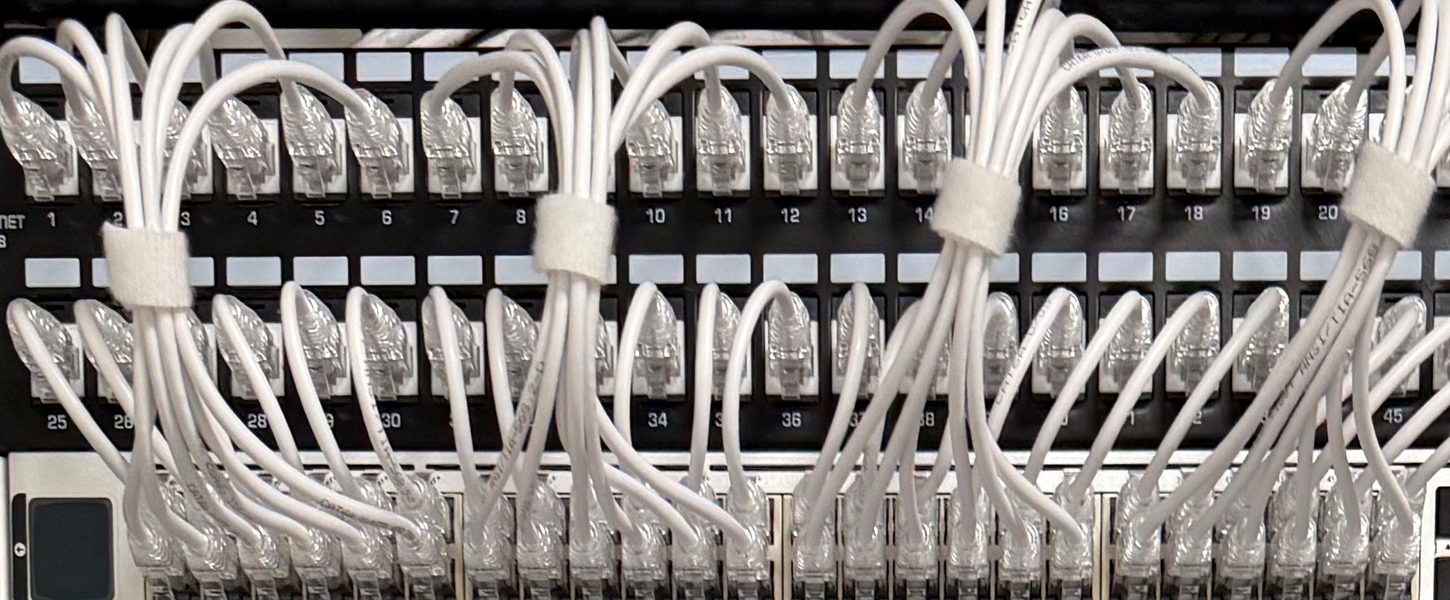
Technology evolves at a breakneck pace. A properly designed structured cabling system organizes your wires into a clean, modular framework (using patch panels and clear labeling). This means when you need to add 50 new workstations, upgrade your server hardware, or integrate a new security system, your infrastructure is already prepared to adapt without requiring a costly, disruptive overhaul.
2. Minimized Downtime and Easier Troubleshooting
We’ve all seen them: the dreaded “spaghetti monster” IT closets where tangled wires hang haphazardly from the racks. If a network switch goes down in a messy room, diagnosing the faulty cable can take hours. Professionally routed and certified low-voltage systems allow our technicians to isolate and fix connectivity issues in minutes, saving your business thousands in lost productivity.
3. Enhanced Performance and Reduced Interference
High-voltage electrical lines emit electromagnetic interference (EMI). If data cables are run too close to electrical lines or lack proper shielding, your network speed will degrade, and data packets will drop. Professional low-voltage installers know exactly how to route and isolate data lines to maximize your bandwidth and prevent signal degradation.
4. Safety and Compliance
Low-voltage cabling must adhere to strict local building codes, National Electrical Code (NEC) standards, and TIA/EIA industry regulations. Using the wrong type of cable jacket (such as using non-plenum cable in air-handling spaces) can create severe fire hazards. Cami Networks ensures every installation is fully compliant, safe, and clean.
Partner with Cami Networks for Your Infrastructure Needs
Building or upgrading your business infrastructure is a massive investment. Don’t let poor cabling choke your company’s potential.
At Cami Networks, we provide end-to-end low-voltage solutions tailored to your unique operational goals. From the initial site survey and architectural blueprinting to precision installation, testing, and lifetime maintenance, we build the networks that power tomorrow’s business.
Ready to optimize your facility’s digital foundation? Contact Cami Networks today to consult with our low-voltage infrastructure specialists. Let’s build a faster, smarter, and more reliable future together.