In the modern enterprise environment, we often obsess over software speeds, cloud migration, and cybersecurity protocols. Yet, we frequently overlook the physical foundation that binds these technologies together: the cabling infrastructure inside your walls.
If your business experiences unexplained network downtime, slow data transfers, or a “spaghetti mess” of tangled wires in your server room, your current setup is likely costing you money.
For businesses across Ventura and Los Angeles County, upgrading to a professionally designed structured cabling system is one of the most effective ways to boost operational efficiency, lower long-term IT costs, and future-proof your facility.
What Exactly is Structured Cabling?
Structured cabling is a standardized, organized approach to building a telecommunications infrastructure. Unlike traditional “point-to-point” cabling—where individual wires are run directly from device to device on an ad-hoc basis—structured cabling creates a unified, predictable architecture.
It divides your building’s entire network into a series of manageable, standardized blocks, utilizing centralized patch panels and clearly labeled pathways.
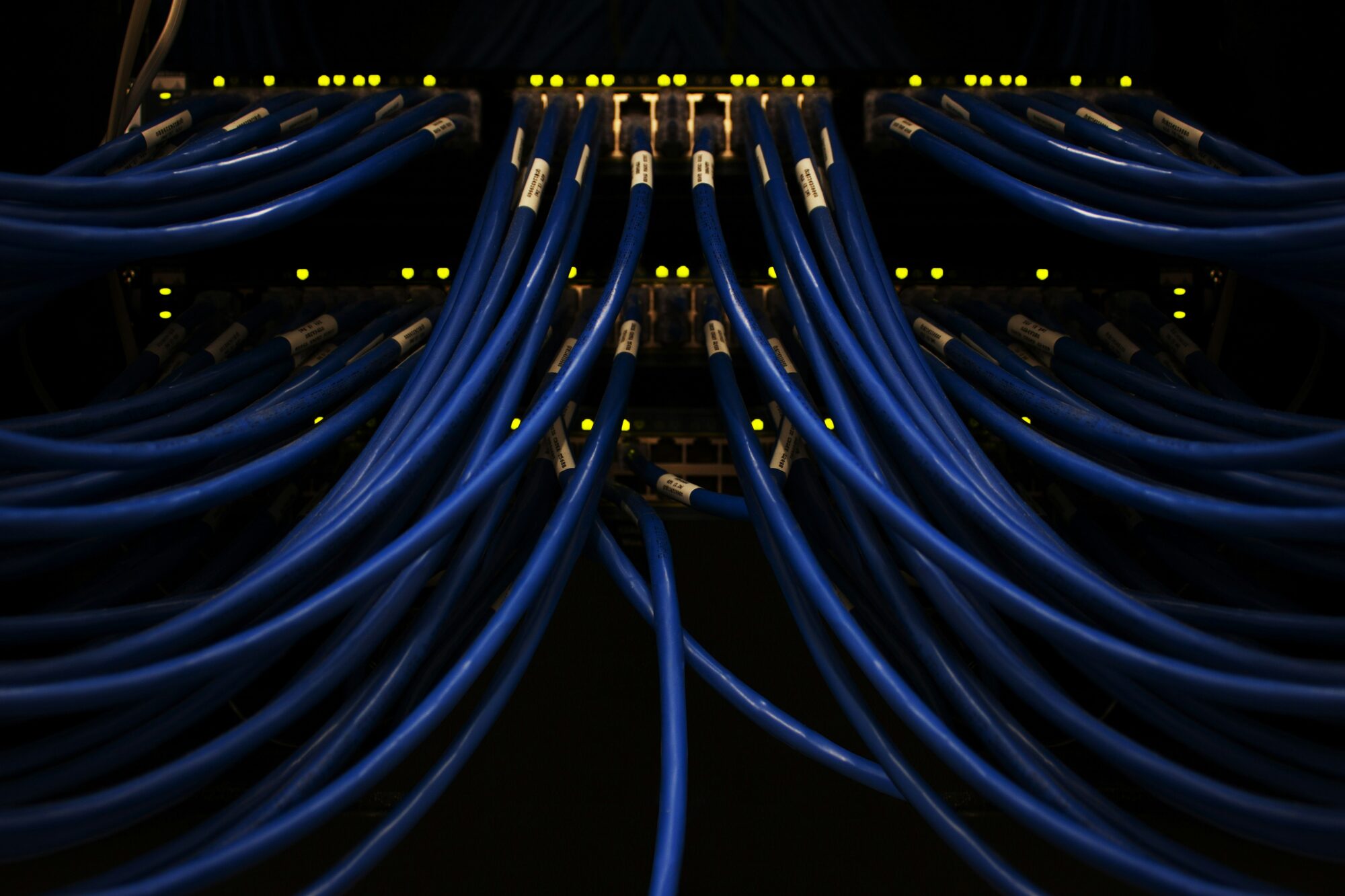
As you can see in the comparison above, moving away from a cluttered, unmanaged setup to a structured layout completely changes how your network functions. It transforms your server room from a chaotic liability into a clean, scalable asset.
Why Structured Cabling is a Game Changer
Transitioning to a structured cabling system offers five major operational advantages:
- Enhanced Reliability and Minimized Downtime: By eliminating tangled “spaghetti” wiring and adhering to strict installation standards, you significantly reduce the risk of human error, accidental disconnects, and signal interference.
- Simplified Troubleshooting: When every cable is tested, documented, and properly labeled at both ends, your IT team or service provider can identify and isolate faults in minutes rather than hours.
- Future-Proof Scalability: Modern structured cabling utilizes high-performance standards like Cat6A and fiber optics. This infrastructure is designed to support high-bandwidth applications today while easily accommodating the next generation of Wi-Fi access points, IoT devices, and security cameras tomorrow.
- Aesthetically Clean and Physically Secure: A well-organized rack isn’t just about looks; it prevents physical strain on the cables and improves airflow, which keeps your active equipment cooler and extends its lifespan.
- Cost-Effectiveness Over Time: While structured cabling requires a deliberate initial design phase, it drastically lowers your total cost of ownership by reducing maintenance expenses and eliminating the need for expensive “rip-and-replace” overhauls every few years.
Structured Cabling vs. Point-to-Point Cabling
To understand the difference, it helps to look at how these two methodologies compare across key operational categories:
| Feature | Point-to-Point (Ad-Hoc) | Structured Cabling (Standardized) |
| Organization | Cables run directly between equipment; leads to a chaotic “spaghetti” mess over time. | Utilizes an organized hierarchy with patch panels, racks, and labeled pathways. |
| Scalability | Extremely difficult to scale; adding new devices often requires pulling entirely new, long cable runs. | Highly modular; adding a new workstation or device requires only a short patch cord change at the panel. |
| Troubleshooting | Tracing a single faulty cable through a massive bundle can take hours and risks disrupting other lines. | Simple and fast; clear labeling and documentation allow for immediate pinpointing of issues. |
| Longevity | Short lifespan; the system quickly degrades as more cables are added over months and years. | Long lifespan; a properly installed system can easily support your business for 10 to 20 years. |
The Components of a Structured System
A standards-compliant structured cabling installation isn’t just about the wires themselves. It integrates six distinct subsystems that work in unison:
- Entrance Facility: The secure point where the external service provider’s network (ISP) enters your building and transitions to your internal network.
- Equipment Room: The centralized heart of your network, housing your main servers, routers, switches, and the primary cross-connect patch panels.
- Backbone Cabling: The high-capacity cables (usually fiber optic or high-grade copper) that provide the connection between your main equipment room and individual telecommunications closets on different floors.
- Telecommunications Room: Smaller, localized distribution points on individual floors or wings that house secondary switches and patch panels.
- Horizontal Cabling: The standard copper or fiber runs that extend from your localized telecommunications room out to the individual wall outlets or ceiling mounts in your work area.
- Work Area: The final interface where your end-user equipment—such as computers, printers, VoIP phones, and wireless access points—plugs into the network.
Industry Standards and Compliance
At Cami Networks, we do not believe in cutting corners. Every infrastructure project we undertake strictly adheres to the guidelines established by the Telecommunications Industry Association (TIA) and the International Organization for Standardization (ISO).
Whether your facility requires Category 6 (Cat6) for standard office data, Category 6A (Cat6A) to support 10-Gigabit speeds and advanced Wi-Fi 7 access points, or Single-Mode/Multi-Mode Fiber Optic backbones for high-speed campus connectivity, we ensure the installation is fully certified.
The Certification Difference: Every single drop we install is tested using specialized certification tools. We verify signal integrity, attenuation, crosstalk, and latency parameters to guarantee that the system performs exactly to its rated standard. You receive a complete test report upon project completion, ensuring total transparency and peace of mind.
Is Your Business Ready for an Infrastructure Upgrade?
Your network infrastructure should be an invisible utility—something that just works flawlessly in the background, day in and day out. If your current cabling setup is creating bottlenecks, preventing you from scaling, or causing regular headaches for your team, it is time to consider a structured approach.
At Cami Networks, we specialize in designing and deploying immaculate, high-performance structured cabling systems tailored to the unique spatial and operational requirements of your business. From initial assessment and engineering to precision installation and certification, we build the digital foundation your company needs to thrive.